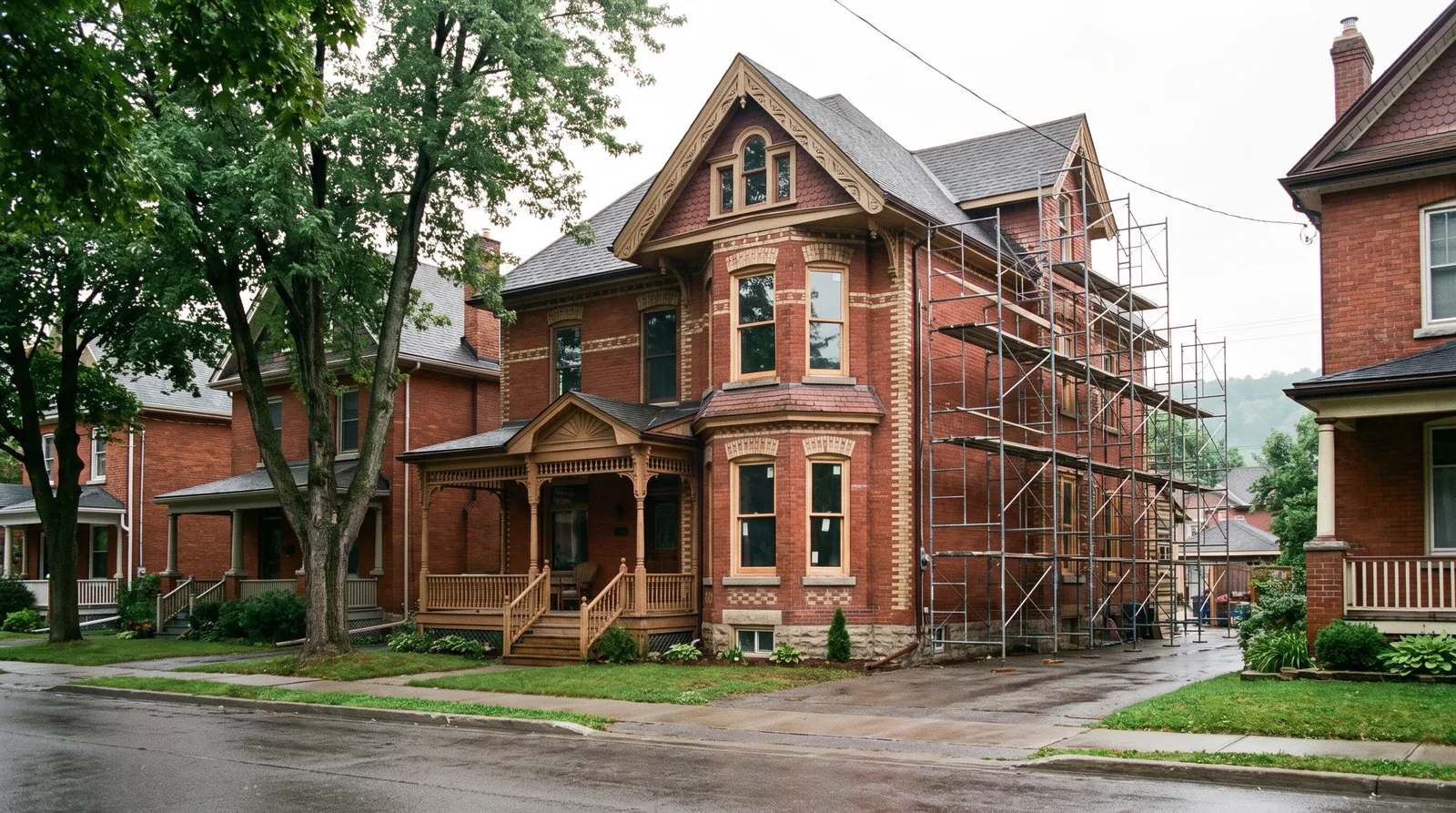
An older housing stock than the province, by a wide margin
32.8% of Hamilton's dwellings were built in 1960 or earlier, against 22.7% across Ontario, and 6.6% need major repairs versus 5.7% provincially. But the city average hides the real story, because age tracks geography almost perfectly. Ward 3 is 74.5% pre-1960 and Ward 4 is 72.3%, while Ward 11 saw 59.6% of its housing built between 2001 and 2021. Hamilton Centre is 59.8% pre-1961. Hamilton Mountain had only 9.2% of its stock built this century. Flamborough and Glanbrook absorbed the growth, at 43.6%.
That matters because it predicts what is behind your walls before we open one.
"Tell me the intersection and I will tell you what we are going to find. A Ward 3 house from the 1890s means knob and tube, plaster over lath and probably a rubble foundation. A Binbrook house from 2008 means builder-grade everything and no surprises. Both are honest work. Only one of them needs a contingency in the contract."
Mitch Fraser, owner, Ontario Contracting Co.
What pre-1960 Hamilton houses actually need
- Knob-and-tube wiring. The Electrical Safety Authority permits existing knob and tube to remain only under three specific conditions, and adding outlets to it voids that allowance entirely. Insurers are typically less forgiving than the ESA, which is why rewiring often leads the budget.
- Asbestos. Ontario Regulation 278/05 requires a designated substance survey before renovation, demolition or repair where asbestos may be present. In Hamilton's pre-1980 stock that is a routine step, not a scare tactic.
- Lead water service lines. Roughly 20,000 homes built before 1955 may still have one, out of about 154,352 service lines citywide.
- Balloon framing and plaster. Continuous wall cavities with no fire-stopping, and finishes that reward patience over speed.
- Stone and rubble foundations, especially in the lower city and Dundas.
Heritage districts change the rules
Hamilton has seven designated heritage conservation districts covering 355 properties: Cross-Melville in Dundas, Durand-Markland, Hamilton Beach, MacNab-Charles, St. Clair Avenue, St. Clair Boulevard, and Mill Street in Waterdown, which at 130 private properties is the largest. An eighth, Melville-Park West in Dundas, reached final draft for community review in February 2026. Inside a district, exterior work needs heritage approval, and specific methods are prohibited outright: no sandblasting, no high-pressure water blasting, no strong chemical cleaning of historic masonry, and no hard cement-based mortar, which cracks brick during freeze-thaw cycles. Our full breakdown is in the Hamilton guides.
What we renovate
Whole-home renovations, main-floor reconfigurations, character restorations, kitchens and bathrooms (see kitchens and bathrooms), and basements where the water question comes first, covered on finishing a Hamilton basement. Every project is priced with a named contingency for concealed conditions and written change orders, the mechanism explained in our change-order guide.